
9th–10th Grade Psychological Mystery Reading Comprehension | Hidden Truths
$5.45
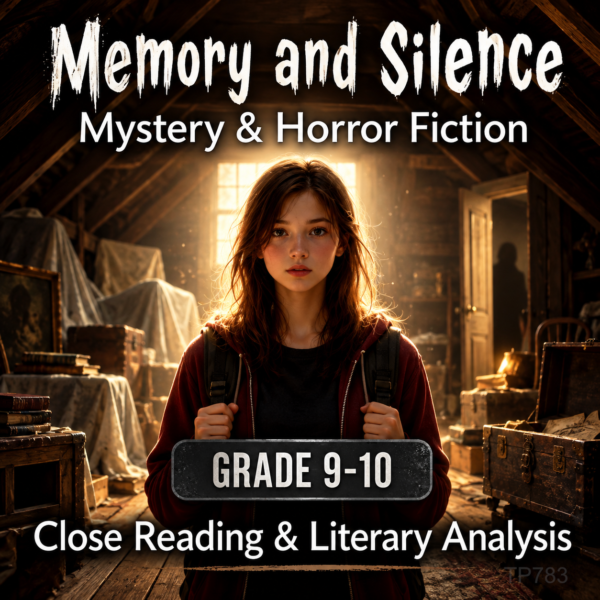
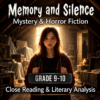
Explore five original psychological mystery stories with this 47-page high school reading comprehension resource for Grades 9–10. Students examine unexplained events, unreliable perceptions, symbolic details, and suspenseful storytelling through 50 open-ended literary analysis questions. Includes complete answer keys, Common Core standards references, and teacher notes for guided instruction or independent practice.
Description
Challenge high school students to look beyond the surface of a story with Hidden Truths, a collection of five psychological mystery and suspense reading passages designed for Grades 9–10 English Language Arts.
Each story begins with an ordinary setting and introduces an unsettling mystery that challenges the characters’ understanding of what is real. Students explore subtle clues, unusual patterns, unexplained experiences, and ambiguous endings while developing close reading and literary analysis skills.
This 47-page printable PDF includes five fiction passages, 50 open-ended literary analysis questions, answer keys with sample responses, and teacher notes for every story.
What Students Will Learn
- Support literary interpretations with textual evidence.
- Identify themes and analyze their development.
- Examine character reactions, motivations, and internal conflicts.
- Make inferences from subtle clues and unexplained events.
- Analyze mood, atmosphere, and descriptive language.
- Explore how repetition and narrative structure build suspense.
- Interpret symbolism and recurring details.
- Explain how narrative perspective shapes the reader’s understanding.
- Analyze ambiguous endings and unresolved conflicts.
- Construct thoughtful written responses supported by evidence.
What’s Included
- 5 psychological mystery and suspense fiction passages
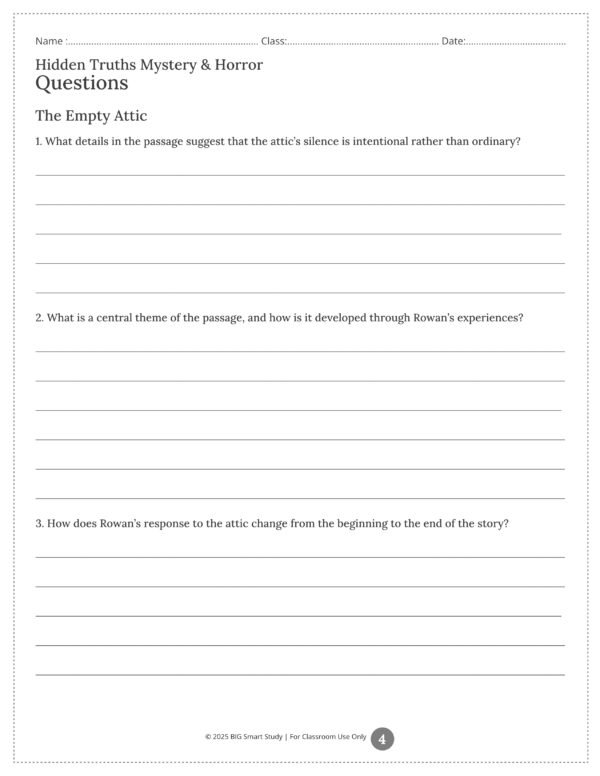
- 50 open-ended reading comprehension and literary analysis questions
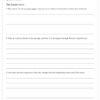
- Writing space for student responses
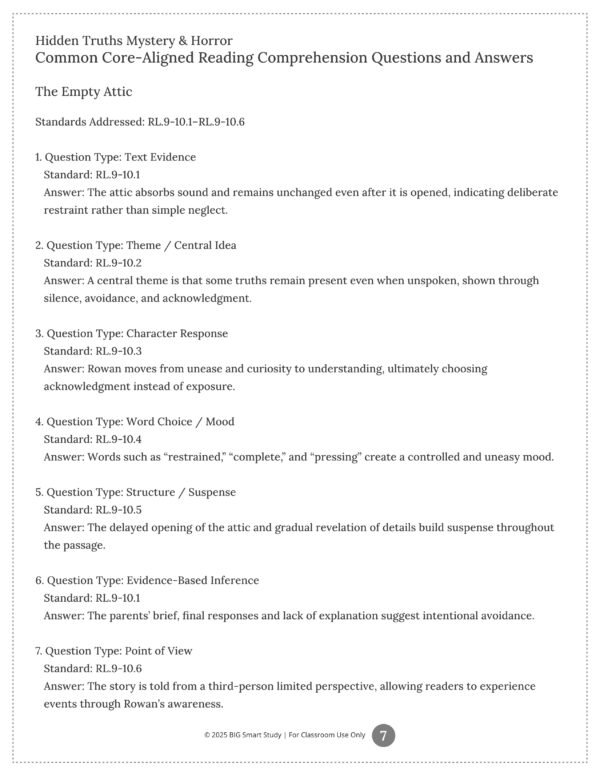
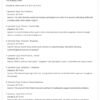
- Answer keys with sample responses for all 5 stories
- Question-level Common Core standards references in the answer keys
- Teacher notes for every story
- Instructional suggestions and skills focus
- 47 printable PDF pages
- Teacher Guide Included: Teaching instructions, learning objectives, and classroom implementation guidance.
Five Psychological Mystery Reading Passages
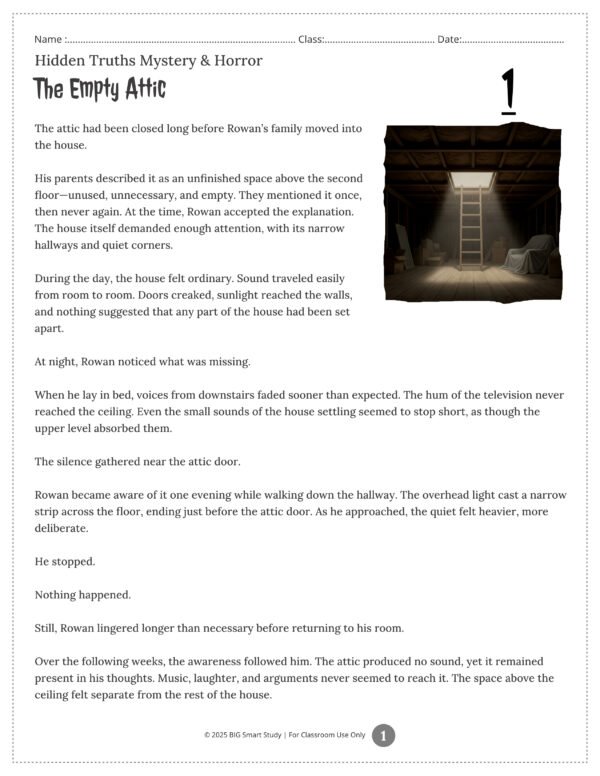
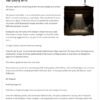
- The Empty Attic: Rowan becomes increasingly aware of the unnatural silence surrounding a closed attic. When he finally investigates, a hidden notebook raises questions about forgotten promises and unacknowledged history. Students examine symbolism, theme, suspense, character response, and the meaning of silence.
- The Last Guest: During a quiet hotel shift, Mara encounters a mysterious visitor who leaves no signature and does not appear on security footage. Students analyze perception, evidence, uncertainty, sensory details, and the relationship between experience and proof.
- Voices in the Stairwell: Elena hears unexplained voices in an apartment building’s stairwell. When she discovers her name carved into the wall, her understanding of the familiar space changes. Students explore repetition, setting, inference, symbolism, and narrative perspective.
- The House Across the Street: Lila notices a figure appearing in a neighboring window at precisely 9:12 p.m. each evening. The mysterious pattern leads her to question whether she is observing someone or being observed herself. Students analyze suspense, perception, character development, and ambiguity.
- The Night the Clock Stopped: Daniel discovers that a hallway clock repeatedly returns to 11:43, even after its battery is replaced or removed. Students investigate how an ordinary object becomes a symbol of unresolved meaning, memory, and uncertainty.
Literary Analysis Skills Covered
- Close reading
- Textual evidence
- Making inferences
- Theme and central idea
- Character development
- Symbolism and interpretation
- Mood, tone, and atmosphere
- Narrative structure and suspense
- Point of view and perspective
- Conflict analysis
- Critical thinking
- Evidence-based written responses
Common Core Standards Alignment
The activities provide practice related to the following Grade 9–10 Common Core English Language Arts standards:
- RL.9-10.1: Cite strong and thorough textual evidence to support literary analysis and inferences.
- RL.9-10.2: Determine a theme or central idea and analyze its development throughout a text.
- RL.9-10.3: Analyze character development, interactions, and contributions to plot or theme.
- RL.9-10.4: Analyze word choice, figurative language, and the effects of language on meaning and tone.
- RL.9-10.5: Analyze how structural choices create effects such as mystery, tension, and surprise.
The original answer keys and teacher notes also reference RL.9-10.6 for point-of-view analysis. These questions provide related practice but do not address the full cultural-perspective requirements of that standard.
How to Use This Resource
Use the five passages individually or as a connected literary analysis unit exploring psychological mystery, perception, and uncertainty.
Each story includes open-ended questions that encourage students to return to the text, identify meaningful details, and explain their interpretations.
Ideal for:
- 9th and 10th grade ELA classrooms
- High school literature instruction
- Mystery and suspense fiction units
- Close reading lessons
- Literary analysis practice
- Text evidence and inference activities
- Independent reading assignments
- Small-group literary discussions
- Written response assessments
- Homework and review
- High school homeschool English
- Substitute teacher lesson plans
The teacher notes recommend approximately 45–60 minutes per passage.
Why Choose This Resource?
Engaging psychological mysteries: Five stories use familiar settings and unexplained events to encourage close attention and thoughtful interpretation.
Higher-level thinking: Students must analyze evidence, examine literary techniques, and explain conclusions rather than simply recall plot details.
Meaningful ambiguity: The stories encourage discussion of uncertainty, perception, and the limits of rational explanation.
Subtle suspense: The passages emphasize atmosphere and psychological tension rather than graphic horror.
Open-ended questions: Ten questions per story support detailed written analysis and evidence-based reasoning.
Answer keys included: Sample responses help teachers evaluate student understanding and guide discussion.
Teacher notes included: Each story provides instructional goals, skills focus, and teaching suggestions.
Preview This Resource
Explore the sample preview to see selected pages from the psychological mystery reading passages and literary analysis activities.
Please Note: The sample preview shows only selected pages from this resource. The complete product includes additional reading passages, worksheets, activities, answer keys, and teacher notes not shown in the preview.
Resource Details
- Grade Level: Grades 9–10
- Subject: English Language Arts (ELA)
- Genre: Psychological Mystery, Horror, and Suspense Fiction
- Resource Type: Reading Comprehension Passages and Worksheets
- Format: Printable PDF
- Total Pages: 47
- Reading Passages: 5
- Open-Ended Questions: 50
- Answer Keys: Included for all 5 passages
- Teacher Notes: Included for all 5 passages
- Suggested Time: 45–60 minutes per passage
- Language: English
Similar Resources
-
Mystery & Suspense Reading Comprehension Worksheets for Grades 9–10 | 5 Short Stories & Literary Analysis
$5.45View This Resource on TPT -
4th Grade Weather and Climate Reading Comprehension Worksheets | 10 Science Passages
$4.75View This Resource on TPT -
4th Grade Human Body Reading Comprehension Worksheets | 10 Science Passages
$4.75View This Resource on TPT -
6th Grade Ancient Rome History Mystery Reading Comprehension | Pompeii
$3.50View This Resource on TPT -
4th Grade Character Traits Reading Comprehension Passages | Text Evidence & Vocabulary
$4.75View This Resource on TPT