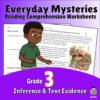
Turn Reading Comprehension Into a Mystery-Solving Challenge
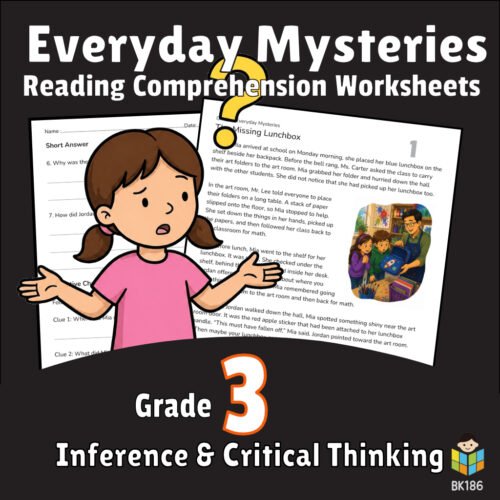
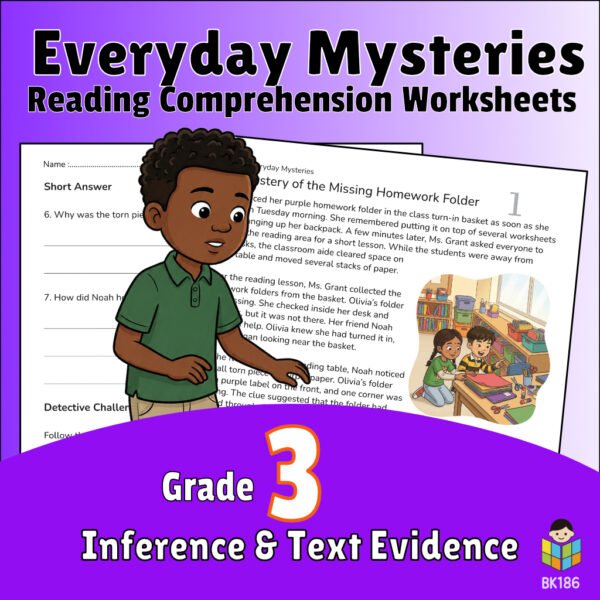
This Grade 3 reading resource uses everyday classroom mysteries to help students practice reading closely, following clues, making inferences, and supporting conclusions with evidence.
Each passage presents a small mystery that can be solved through careful reading rather than guessing. Students identify important details, compare possible explanations, and use evidence from the text to determine what most likely happened.
The mystery format gives comprehension practice a clear purpose: students are not simply answering questions—they are using what they read to solve a problem.
Read, Notice Clues, and Build an Explanation
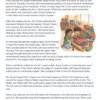
Each mystery begins with a short narrative based on a familiar school situation.
Students encounter problems such as:
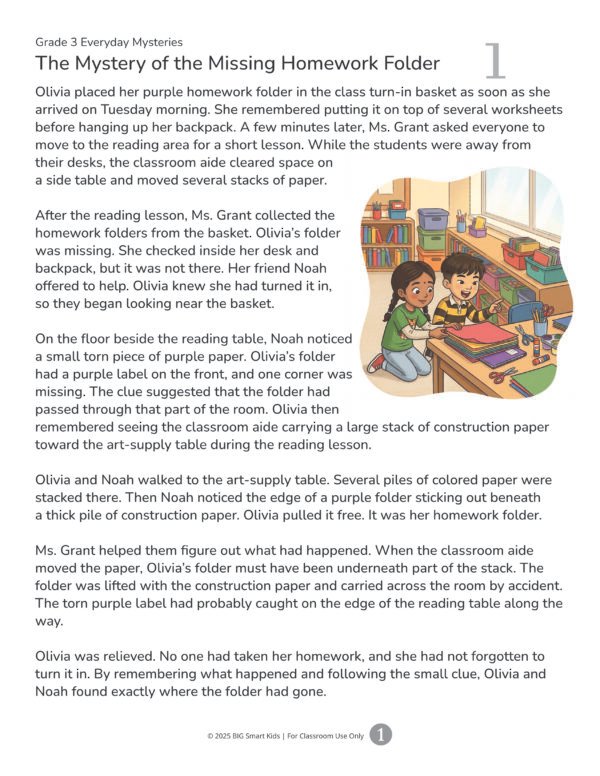
- A homework folder that suddenly disappears
- A mysterious puddle beside a classroom sink
- Chairs that have been moved
- Colored chalk that keeps vanishing
- A strange smell in the hallway
- A pencil cup that changes position
- A gym door left open
- A crooked bulletin board
- An extra library book
- A bell that seems to ring twice
The clues are embedded naturally within each passage, giving students repeated opportunities to distinguish important evidence from less useful details.
Practice Reading Comprehension Skills
After each passage, students answer multiple-choice and short-answer questions.
The questions ask students to work with skills such as:
- Recalling key details
- Identifying important clues
- Determining cause and effect
- Making logical inferences
- Explaining character actions
- Identifying the main lesson
- Supporting answers with passage evidence
Follow the Clues
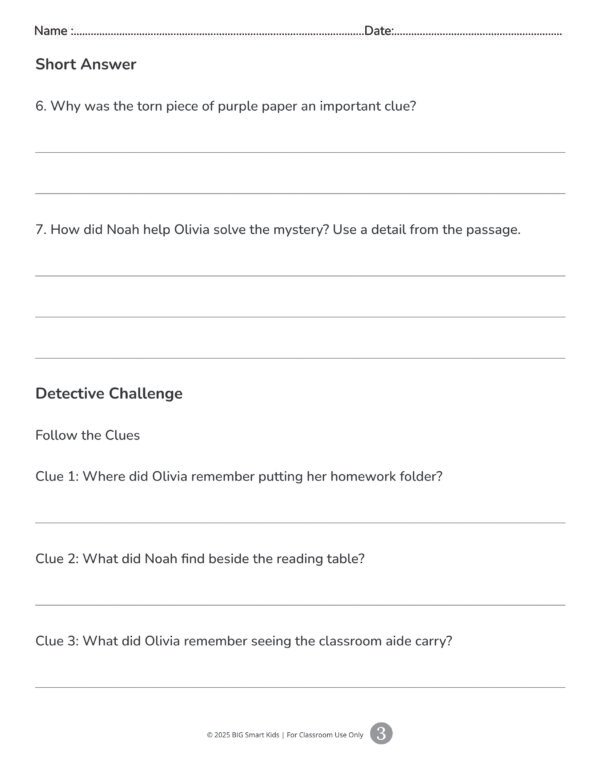
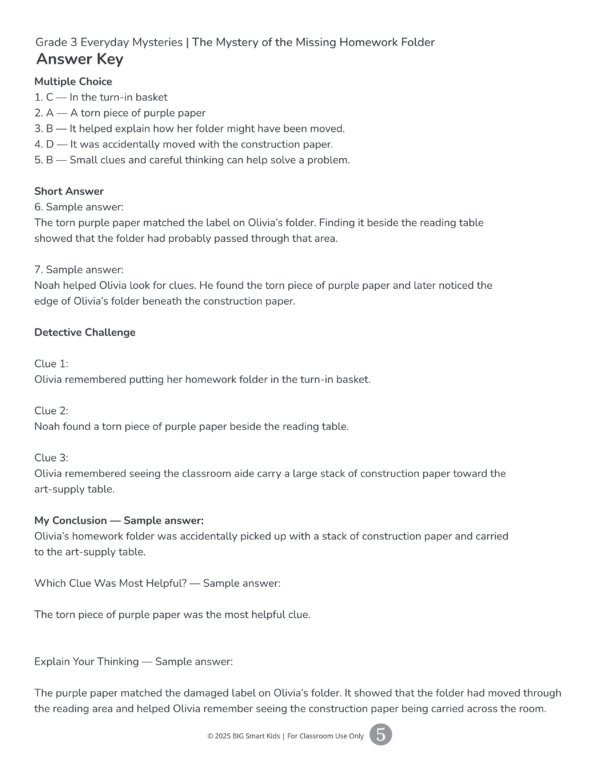
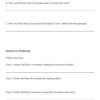
Each mystery includes a Detective Challenge that asks students to revisit the passage and identify the clues that led to the solution.
Students organize evidence rather than relying on a single detail.
This repeated structure helps them practice connecting information across a text and seeing how several clues can work together to support one conclusion.
Make a Conclusion and Explain the Reasoning
Students then decide what most likely happened in the mystery.
They are asked to:
- State a conclusion
- Identify the most useful clue
- Explain why that clue matters
This creates a natural bridge between reading comprehension and evidence-based reasoning.
Students must move beyond simply choosing an answer and explain how the text supports their thinking.
Build Inference and Critical-Thinking Skills
The stories are designed so that the solution develops from details in the passage.
Students practice asking:
- What do I know from the text?
- Which clues are most useful?
- What explanation fits all the evidence?
- Which details rule out another explanation?
- How can I explain my conclusion clearly?
These questions help build inference and critical-thinking skills within an accessible Grade 3 reading format.
What Students Practice
- Reading comprehension
- Close reading
- Main idea and lesson
- Key details
- Inference
- Cause and effect
- Evidence from text
- Logical reasoning
- Clue analysis
- Drawing conclusions
- Short-answer writing
- Explaining thinking
- Critical thinking
What’s Included
- 10 Everyday Mystery Reading Passages
- Multiple-Choice Comprehension Questions
- Short-Answer Questions
- Detective Challenge Activities
- Follow-the-Clues Sections
- Conclusion Questions
- Most-Helpful-Clue Analysis
- Explain-Your-Thinking Prompts
- Complete Answer Keys
Mystery Topics Included
- The Mystery of the Missing Homework Folder
- The Puddle Beside the Classroom Sink
- The Case of the Mixed-Up Chairs
- The Mystery of the Vanishing Chalk
- The Strange Smell in the Hallway
- The Mystery of the Moving Pencil Cup
- Who Left the Gym Door Open?
- The Mystery of the Crooked Bulletin Board
- The Case of the Extra Library Book
- The Mystery of the Bell That Rang Twice
Best Uses for This Resource
This resource can work well for:
- Grade 3 reading comprehension
- Close-reading practice
- Inference lessons
- Text-evidence practice
- Critical-thinking activities
- Independent reading work
- Small-group reading
- Literacy centers
- Morning work
- Homework
- Substitute plans
- Early finisher activities
- Reading review
Resource Details
Grade: 3
Subject: Reading / ELA
Resource Type: Reading Comprehension Mystery Worksheets
Focus Skills: Inference, Evidence, Conclusions, Critical Thinking
Length: 50 pages
Includes: 10 Mystery Passages, Student Activities, and Answer Keys