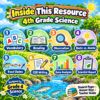
Explore Freshwater Ecosystems Through Reading, Observation, Data, and Scientific Reasoning
This Grade 4 science resource gives students a connected way to study how a freshwater ecosystem works.
Instead of practicing ecosystem concepts in isolation, students return to the same stream habitat as they read, observe, classify, analyze, and explain what is happening within the ecosystem.
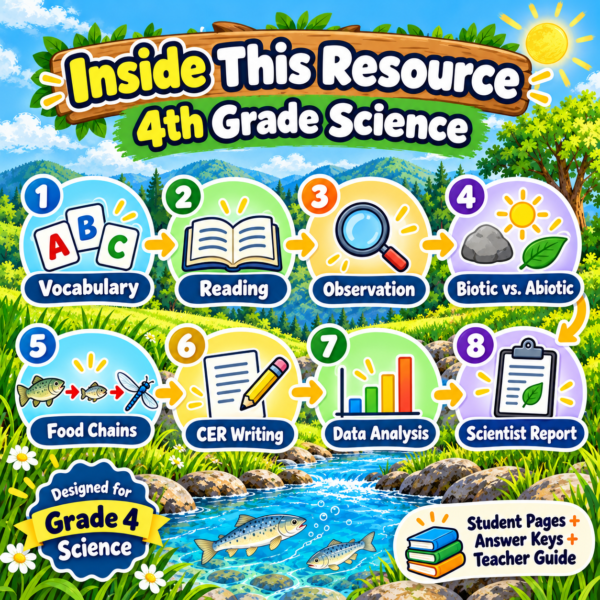
The activities move from foundational vocabulary and reading comprehension into food chains, energy flow, environmental change, evidence-based reasoning, data analysis, and CER writing.
Build Background Knowledge First
Students begin with key ecosystem vocabulary and a reading passage about life in a freshwater stream.
They explore how living and nonliving parts interact, including fish, insects, plants, water, sunlight, rocks, soil, air, and temperature.
This foundation prepares students to work with more complex ecosystem relationships later in the resource.
Identify Biotic and Abiotic Factors
Students observe a freshwater ecosystem scene and identify examples of both living and nonliving factors.
They classify biotic and abiotic factors and consider what different organisms need from their habitat.
These activities help students connect science vocabulary to a realistic freshwater environment.
Explore Food Chains and Energy Flow
Students examine the roles of producers, consumers, and decomposers before working with a freshwater food chain.
They identify how organisms obtain energy, interpret food-chain arrows, arrange organisms in the correct sequence, and explain how a change in one part of the food chain may affect another organism.
Freshwater Energy Pathway
Sun → algae → aquatic insect → small fish → larger fish
Students use this pathway to trace how energy enters the ecosystem and moves through producers and consumers.
Think About Ecosystem Change
Students consider how environmental changes may affect organisms and conditions within a freshwater ecosystem.
Scenarios include:
- Reduced rainfall
- Polluted runoff
- Cloudier water
- Removal of plants along the stream bank
Students predict possible effects and explain how changes in one part of an ecosystem may influence other organisms or environmental conditions.
Use Evidence and CER in Science
Students use evidence from the ecosystem scene to evaluate scientific claims about habitat quality, biotic and abiotic factors, and the importance of plants.
They also complete a Claim-Evidence-Reasoning (CER) activity in which they decide whether the freshwater stream provides a suitable habitat for fish.
Students support their claim with observations or facts and explain how the evidence connects to their scientific reasoning.
Analyze Environmental Data
Students work with a before-and-after stream data table showing changes following a period of low rainfall.
They examine:
- Water depth
- Water temperature
- Water clarity
- Fish observations
- Aquatic insect observations
Students identify patterns, suggest possible explanations, and consider what additional information scientists might collect.
The activity also reinforces an important science practice: recognizing that a data pattern does not automatically prove a cause.
Bring the Learning Together
At the end of the resource, students complete a Freshwater Ecosystem Scientist Report.
Students synthesize what they have learned by:
- Describing the freshwater habitat
- Identifying biotic factors
- Identifying abiotic factors
- Writing a food chain
- Explaining how one ecosystem change may affect multiple organisms
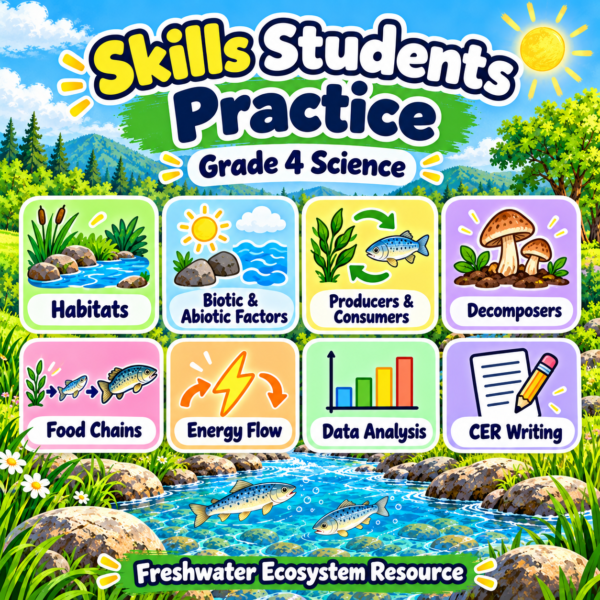
What Students Practice
- Ecosystem vocabulary
- Freshwater habitats
- Biotic and abiotic factors
- Producers, consumers, and decomposers
- Organism needs
- Food chains
- Energy flow
- Ecosystem relationships
- Environmental change
- Scientific observation
- Evidence-based explanations
- Environmental data analysis
- Claim-Evidence-Reasoning
- Science report writing
What’s Included
- Teacher Guide
- Ecosystem Vocabulary Warm-Up
- Freshwater Stream Reading
- Reading Comprehension
- Ecosystem Observation Activity
- Biotic and Abiotic Classification
- Organism Needs Activity
- Producers, Consumers & Decomposers
- Freshwater Food Chain Activities
- Energy Flow Practice
- Ecosystem Change Scenarios
- Evidence-Based Science Questions
- Mini CER Activity
- Environmental Data Table
- Stream Data Analysis
- Ecosystem Review
- Freshwater Ecosystem Scientist Report
- Complete Answer Keys
Best Uses for This Resource
This resource can work well for:
- Grade 4 ecosystem units
- Life science instruction
- Whole-class guided practice
- Small-group science work
- Independent practice
- Science centers
- Science and reading integration
- CER practice
- Data-analysis practice
- Review and assessment
Resource Details
Grade: 4
Subject: Science
Topic: Freshwater Ecosystems
Format: Printable PDF
Length: 34 pages
Includes: Student Pages, Answer Keys, and Teacher Guide