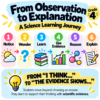
Investigate Condensation Through a Real-World Science Mystery
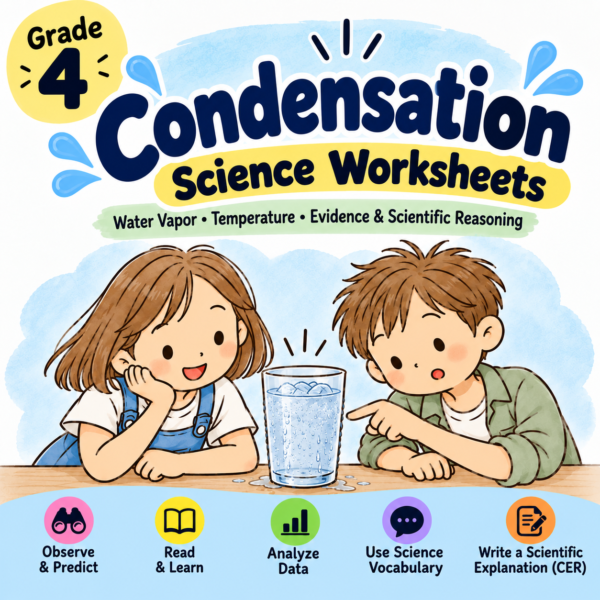
Why do water droplets appear on the outside of a cold glass?
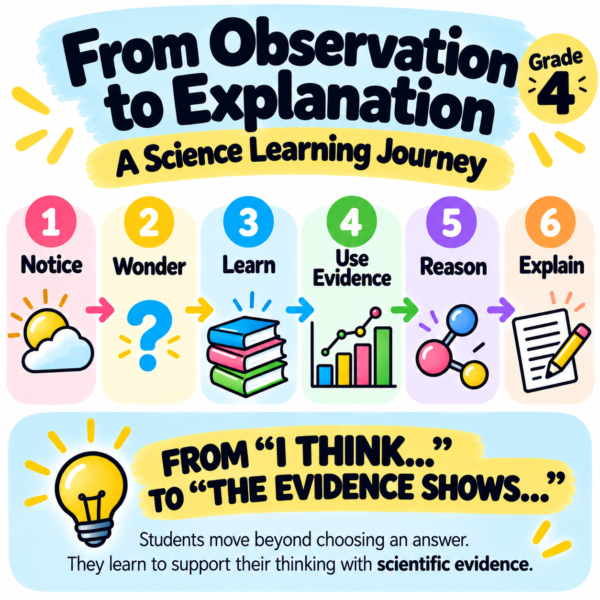
This Grade 4 science resource turns that familiar observation into a connected investigation of condensation, water vapor, temperature, states of matter, evidence, and scientific reasoning.
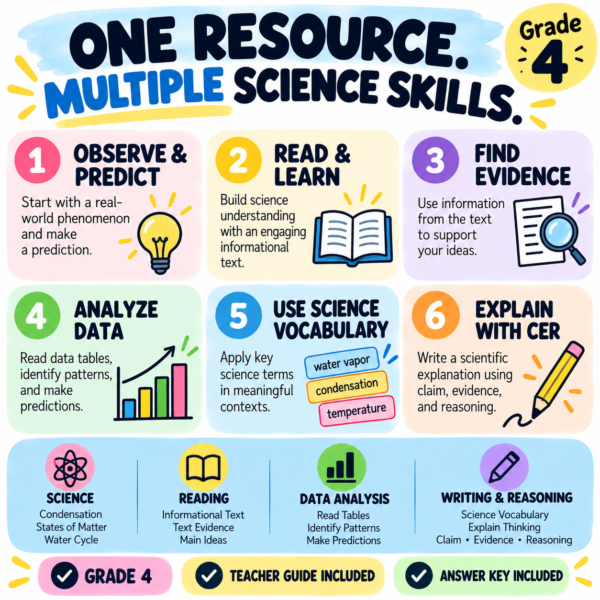
Instead of giving students the answer immediately, the activities begin with observation and prediction. Students then gather information from reading, compare evidence, examine temperature-related results, analyze data, apply science vocabulary, and finally construct a Claim-Evidence-Reasoning explanation.
Start With Observation and Prediction
Students begin by observing a cold glass with water droplets forming on the outside.
They consider possible explanations and make an initial prediction about where the water came from.
This gives students a starting idea that they can revisit after gathering scientific evidence.
Learn How Condensation Happens
Students read an informational science passage explaining how water vapor in the air can cool near a cold surface and change from a gas into liquid water.
The resource reinforces the relationship:
Water vapor in the air → cooling → liquid water droplets
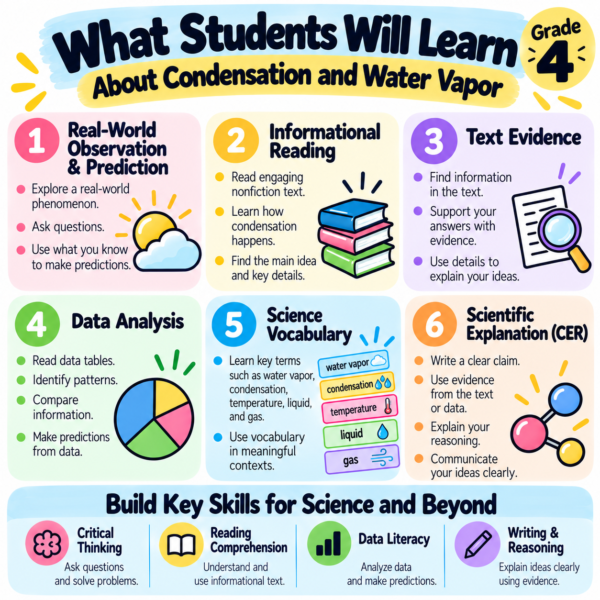
Students also work with key ideas about water vapor, temperature, gases, liquids, and condensation.
Find and Use Scientific Evidence
Students return to the reading to identify information that helps explain the original observation.
They practice distinguishing between:
- An initial idea
- Relevant evidence
- A scientifically supported explanation
Students also evaluate which evidence best supports the conclusion that the water droplets came from the surrounding air rather than leaking through the glass.
Investigate Temperature and Condensation
Students compare glasses at different temperatures and think about how surface temperature may affect condensation.
Activities ask students to:
- Make predictions
- Compare conditions
- Examine observations
- Interpret results
- Explain what the evidence suggests
This helps move students from simply defining condensation to reasoning about the conditions that influence it.
Analyze Condensation Data
Students work with temperature and condensation data from glasses kept under comparable conditions.
They compare:
- Water temperature
- Number of droplets observed
- Patterns across different temperatures
Students use the data to identify trends, answer questions, make predictions, and support conclusions with evidence.
The resource also encourages careful scientific language by showing students that instructional data can reveal patterns without automatically proving a universal rule.
Apply Science Vocabulary in Context
Students use key vocabulary to explain what is happening rather than simply matching terms with definitions.
Key science words include:
- Water vapor
- Condensation
- Temperature
- Liquid
- Gas
Students apply these terms to real situations and revise scientifically incorrect explanations using more accurate language.
Build a Claim-Evidence-Reasoning Explanation
The investigation concludes with a CER Science Explanation Challenge.
Students return to the original question:
Where did the water drops on the outside of the cold glass come from?
They develop:
- Claim — an answer to the science question
- Evidence — information from reading, observations, or data
- Reasoning — an explanation connecting the evidence to what they learned about condensation
Students then combine all three parts into a complete scientific explanation.
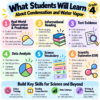
What Students Practice
- Condensation
- Water vapor
- Gas-to-liquid changes
- Temperature
- States of matter
- Scientific observation
- Prediction
- Informational science reading
- Finding text evidence
- Comparing conditions
- Data interpretation
- Pattern recognition
- Science vocabulary
- Evidence-based explanations
- Claim-Evidence-Reasoning
What’s Included
- Teacher Guide
- Observe & Predict Activity
- Informational Science Reading
- Reading Comprehension
- Find the Evidence Activities
- Science Evidence Challenge
- Temperature and Condensation Investigation
- Observation Comparison
- Temperature Data Analysis
- Pattern and Prediction Questions
- Science Vocabulary in Context
- Scientific Sentence Revision
- CER Science Explanation Challenge
- Complete Answer Keys
Best Uses for This Resource
This resource can work well for:
- Grade 4 science instruction
- Water cycle lessons
- States of matter lessons
- Condensation review
- Whole-class guided instruction
- Small-group science work
- Independent practice
- Science and reading integration
- Data-analysis practice
- CER introduction or practice
- Evidence-based science writing
- Review or reinforcement
Resource Details
Grade: 4
Subject: Science
Topic: Condensation
Related Concepts: Water Vapor, Temperature, States of Matter
Format: Printable PDF
Length: 30 pages
Includes: Student Pages, Teacher Guide, and Answer Key